
Allow four hours, not two. Start upstairs at the Tutankhamun galleries before the coaches reach them, walk the grand staircase downwards rather than up, and accept before you go in that you will not see all of it.
The Grand Egyptian Museum opened fully on 1 November 2025, after two decades of delays that became a running joke among people who work in Egyptian tourism. It sits on the plateau edge about two kilometres from the pyramids, and it is now the largest museum in the world devoted to a single civilisation.
It is also, for the first time since Howard Carter emptied the tomb in the 1920s, the place where the complete Tutankhamun burial assemblage is shown together. That alone changes how a Cairo day should be planned.
The practical facts
| Detail | |
|---|---|
| Opened fully | 1 November 2025 |
| Ticket, foreign adult | around 1,450 to 1,500 EGP, roughly 28 US dollars |
| Hours | 9am to 6pm, and to 9pm on Wednesday and Saturday |
| Time to allow | Four hours as a minimum. Six if you read labels |
| Distance from Giza pyramids | about 2 km |
| Tutankhamun galleries | included in standard admission on most days |
What to do first
Go up. The Tutankhamun galleries are on the upper level and they are the thing everybody has come for, which means they fill from mid-morning. If you are through the door at nine and go straight up, you get an hour with the collection before it becomes a crowd.
Then work downwards through the main galleries, which are organised by period and by theme, and finish in the grand hall with the colossal Ramesses II. Most people do this in reverse, because the hall and the staircase are in front of them when they walk in, and they arrive at Tutankhamun tired and at the busiest hour.
What is actually there
The grand staircase. Six flights lined with royal statuary arranged so that the sculpture gets larger as you climb, ending with a window onto the pyramids themselves. It is theatrical and it works.
The Tutankhamun galleries. More than five thousand objects, the whole contents of the tomb, laid out roughly as they were found rather than as isolated masterpieces. The nested shrines and the chariots make far more sense here than they ever did crammed into the old museum on Tahrir Square.
The main galleries. Predynastic through to the Roman period, and this is where the museum quietly becomes very good. Objects that were in storage for decades are out, well lit and properly labelled, which was not true of Egyptian museums for most of the last century.
The hanging obelisk. A Ramesses II obelisk raised so that you can walk underneath and see the base, which is normally buried. A small thing, and the sort of detail that tells you the curators were thinking.
What to skip
If you have four hours rather than six: skip the children’s museum, skip the commercial area, and do not attempt the solar boat as well on the same visit. Do not try to combine a full GEM visit with the Egyptian Museum on Tahrir Square in one day. People do it, and they remember neither.
Does it replace the old Egyptian Museum?
No, and this catches people out. The museum on Tahrir Square is still open and still holds a great deal, including the royal mummies collection that moved to the National Museum of Egyptian Civilisation rather than to GEM.
If you have one day in Cairo, go to GEM. If you have two, the old museum on the second day is a completely different pleasure: crowded, dusty, badly labelled, and stuffed with things nobody has got round to moving. Some people prefer it.
Combining it with the pyramids
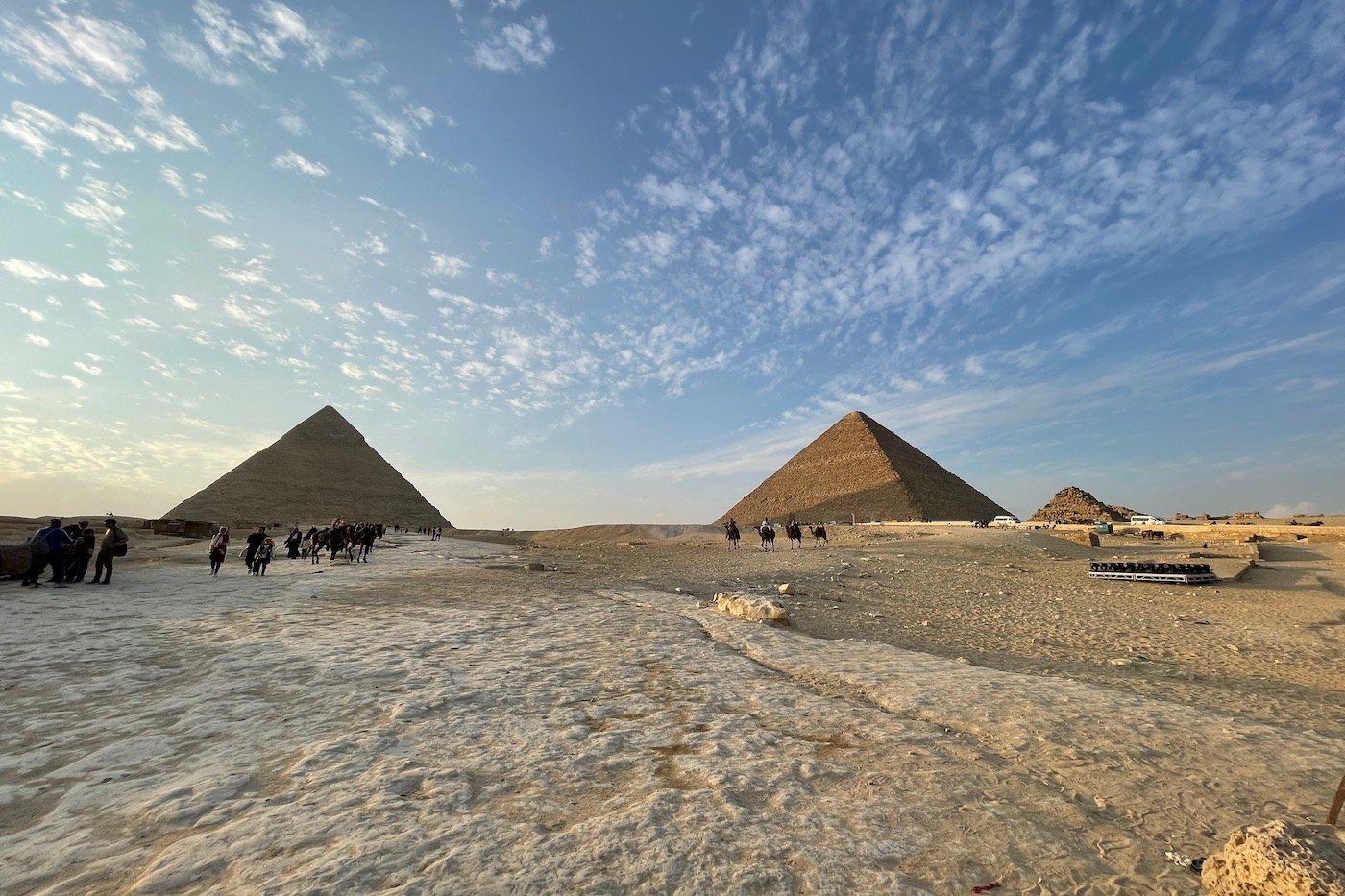
They are two kilometres apart and the natural pairing, but it is a full day rather than a half. Pyramids first thing, when the plateau is cool and the light is good, then the museum from late morning. That order also means the museum’s air conditioning arrives at the hottest part of the day, which matters more than it sounds.
Our day trip from Hurghada does exactly this, and our multi-day journeys through Cairo and the Nile give it a morning of its own.
Getting there and getting in
The museum is at the Giza end of the Cairo-Alexandria desert road, not in central Cairo. From Zamalek or downtown allow forty-five minutes in ordinary traffic and rather more at the wrong hour. From a hotel in Giza it is ten minutes.
Buy tickets online in advance if you can. The queue at the counter is the one avoidable part of the day. Security at the entrance is airport-style and there is a bag size limit, so leave the large rucksack in the car.
There is a cafe and a food hall inside, and the food is unremarkable and priced for a captive audience. This is not a criticism unique to Cairo.
Is it worth it if you saw the old museum years ago?
Yes, and more so than you might assume. It is not the same objects rehoused. A large proportion of what is on display has not been publicly shown in living memory, because the old building had space for a fraction of the collection and the rest sat in storage.
The Tutankhamun material is the clearest case. In the old museum you saw the mask, the coffins and a selection of the famous pieces in glass cases in a crowded room. Here you see the tomb as an assemblage: the beds, the chariots, the walking sticks, the linen, the food. It stops being a treasure hoard and starts being a burial, which is a different and better thing to look at.
One honest warning
The building is enormous, and enormous means walking. From the entrance to the far end of the upper galleries and back is a serious distance on hard floors. Wear the shoes you would wear for a day of sightseeing, not the ones you would wear to a museum in Europe, and sit down before you need to.