
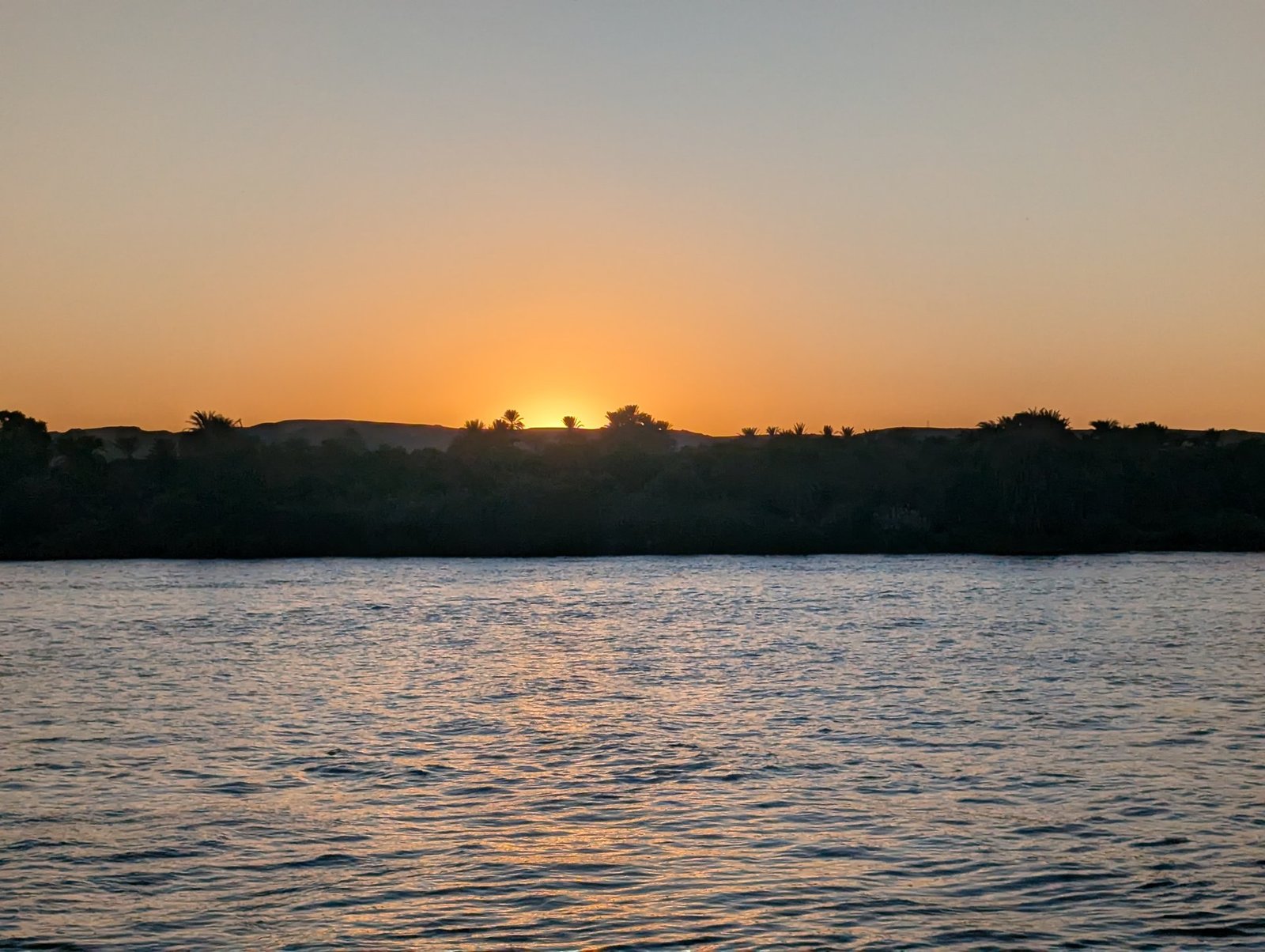
October to April, if you have the choice. The rest of this explains what that actually means month by month, and what to do if your holiday falls in July.
Egypt has two seasons that matter to a traveller: the months you can walk around a temple at midday, and the months you cannot. Everything else is detail.
The short version
| Months | What it is like | Verdict |
|---|---|---|
| October | Heat easing, river still warm, crowds building | Excellent |
| November | Comfortable days, cool evenings | Excellent |
| December | Cool, bright, busiest and dearest | Very good, book early |
| January | Coldest month, cold nights on the water | Very good, pack a jumper |
| February | Comfortable, still busy | Excellent |
| March | Warm, occasional dust winds | Excellent |
| April | Warming fast, Khamsin winds possible | Good, go early in the month |
| May to September | Very hot in Upper Egypt | Only with an adapted plan |
October and November
The best month is November and it is not close. The summer heat has gone, the light is long and low, and it is warm enough at eight in the morning to be comfortable in a shirt and cool enough at four to keep walking. October is nearly as good, with slightly hotter afternoons.
December and January
Egypt’s high season. Bright, dry, and cool enough that you will want a fleece after sunset, particularly on a boat, where the temperature drops the moment the sun goes. Cabins on the smaller boats sell out for Christmas and New Year months ahead, and prices rise accordingly.
January nights in Upper Egypt can fall to eight or nine degrees. Guests who have packed only for a hot country are cold, every year, without fail.
February and March
Two of the finest months, with slightly fewer people than December. March brings the first possibility of Khamsin: a hot southerly wind carrying sand, which turns the sky yellow and makes a day unpleasant rather than dangerous. It blows for a day or two at a time, occasionally, mostly between March and May.
April
The first half is still comfortable. By the end of the month Luxor and Aswan are moving into the forties and the character of a day changes. If you are choosing between early April and late April, choose early.
May to September, and what to do about it
Upper Egypt in high summer is genuinely hot. Forty to forty-five degrees in the afternoon is ordinary. This is not a reason to cancel a trip, but it is a reason to build it differently.
What works in summer:
- Starting at first light and being finished by eleven. Karnak at opening in July is a real pleasure.
- The Nile itself. A boat has shade and moving air, and it is far more bearable than a bus.
- The Red Sea, where the sea breeze makes forty degrees feel like something you can live in.
- Cairo, which is hot but survivable, and where much of the interest is indoors.
- Fewer people at every site, and lower prices almost everywhere.
What does not work: long walking days on the West Bank, and anything that has you outside between noon and four. That is why our West Bank morning goes out at first light rather than mid-morning, and why we would talk you out of booking it for the middle of a July day.
What the numbers look like
Luxor is hotter than Cairo and hotter than the coast, so if you keep one place in your head, keep this one. Climate averages for 1991 to 2020:
| Month | Average high | Average low |
|---|---|---|
| January | 22.8 °C | 7.0 °C |
| February | 25.4 °C | 8.7 °C |
| March | 29.7 °C | 12.6 °C |
| April | 35.0 °C | 17.3 °C |
| May | 39.1 °C | 22.0 °C |
| June | 41.3 °C | 24.5 °C |
| July | 41.5 °C | 25.7 °C |
| August | 41.2 °C | 25.5 °C |
| September | 39.4 °C | 23.2 °C |
| October | 35.5 °C | 19.5 °C |
| November | 29.2 °C | 13.3 °C |
| December | 24.2 °C | 8.5 °C |
Treat these as the shape of the year rather than a forecast. The point they make is the one that matters: the gap between day and night in winter is fifteen degrees or more, and almost nobody packs for the second number.
What to pack, by season
- November to March: layers. A fleece or jacket for evenings and for a boat deck after dark, and long sleeves for the sun during the day.
- April and October: hot-weather clothing, plus something for one cool evening.
- Summer: the lightest loose cotton or linen you own, a hat with a brim, sunglasses, and more water than you think. Not shorts and a vest, which sound sensible and are not.
A note on Ramadan
Ramadan moves each year, and many guests like to travel in this month. Sites stay open; opening hours shift, and restaurants in smaller places may not serve in daylight. The roads are busy in the hour before sunset, when everyone is heading home to break the fast, and the evening that follows is the most festive of the year. As a guest you simply eat, drink and smoke discreetly in public during daylight. We will tell you where the dates fall for your trip.
So when should you go?
If you are free to choose: the first half of November, or February. If you have children in school: late October or Easter, with Easter meaning early April rather than late. If you can only travel in summer: come, but put the Nile and the Red Sea at the centre of the trip and let us build the days around the heat rather than pretending it is not there.
Season decides more than comfort on some trips. The Western Desert is a winter proposition - nights get cold and days stay walkable, which is why the Nile and the White Desert in nine days belongs in the months above and not in June. The same goes for the long routes: twelve days from Cairo to Abu Simbel is a pleasure between November and March and an endurance test in August.
The same logic applies to a dahabeya under sail: without an engine to fall back on, it depends on the steadier winds of the cooler months, and is at its best in exactly the window above.
Two things worth settling once you have picked a month: entry requirements and how money works in Egypt.
Auf Deutsch lesen: Beste Reisezeit für Ägypten - Monat für Monat
Keep reading: The Grand Egyptian Museum: how long you need, and what to skip · Dahabeya or Nile cruise ship? An honest comparison · Cairo, the Nile & the Red Sea - 9 Days · Cairo, Fayoum, Luxor & the Red Sea - 10 Days · Nile cruise with children: from what age does it work? · Abu Simbel from Aswan: by road or by air