
Your ticket covers three tombs out of the eight or nine open on any given day. Which three you choose makes more difference to the morning than almost anything else, and most visitors pick by whichever queue is shortest.
The Valley of the Kings is not one monument. It is sixty-odd tombs cut into a limestone wadi, of which a rotating handful are open while the others rest or are being conserved. The standard ticket lets you into three of the open ones. Three more are sold separately and two of those are worth thinking about.
What it costs, August 2026
| Ticket | Price for a foreign adult | Roughly |
|---|---|---|
| General entry, includes any three open tombs | 750 EGP | 14 US dollars |
| Tutankhamun, KV62 | 700 EGP extra | 13 US dollars |
| Ramesses V and VI, KV9 | 220 EGP extra | 4 US dollars |
| Seti I, KV17 | 2,000 EGP extra | 38 US dollars |
| Photography with a mobile phone | free |
Prices are set by the Ministry and change, usually upward and usually in November. Treat these as the shape of it.
The three that are usually worth your standard ticket
Ramesses III, KV11. Long, wide, and painted almost the whole way down, with side chambers showing craftsmen, boats and harpists rather than only gods. If a visitor is going to remember one tomb, it is often this one, and it is rarely the busiest.
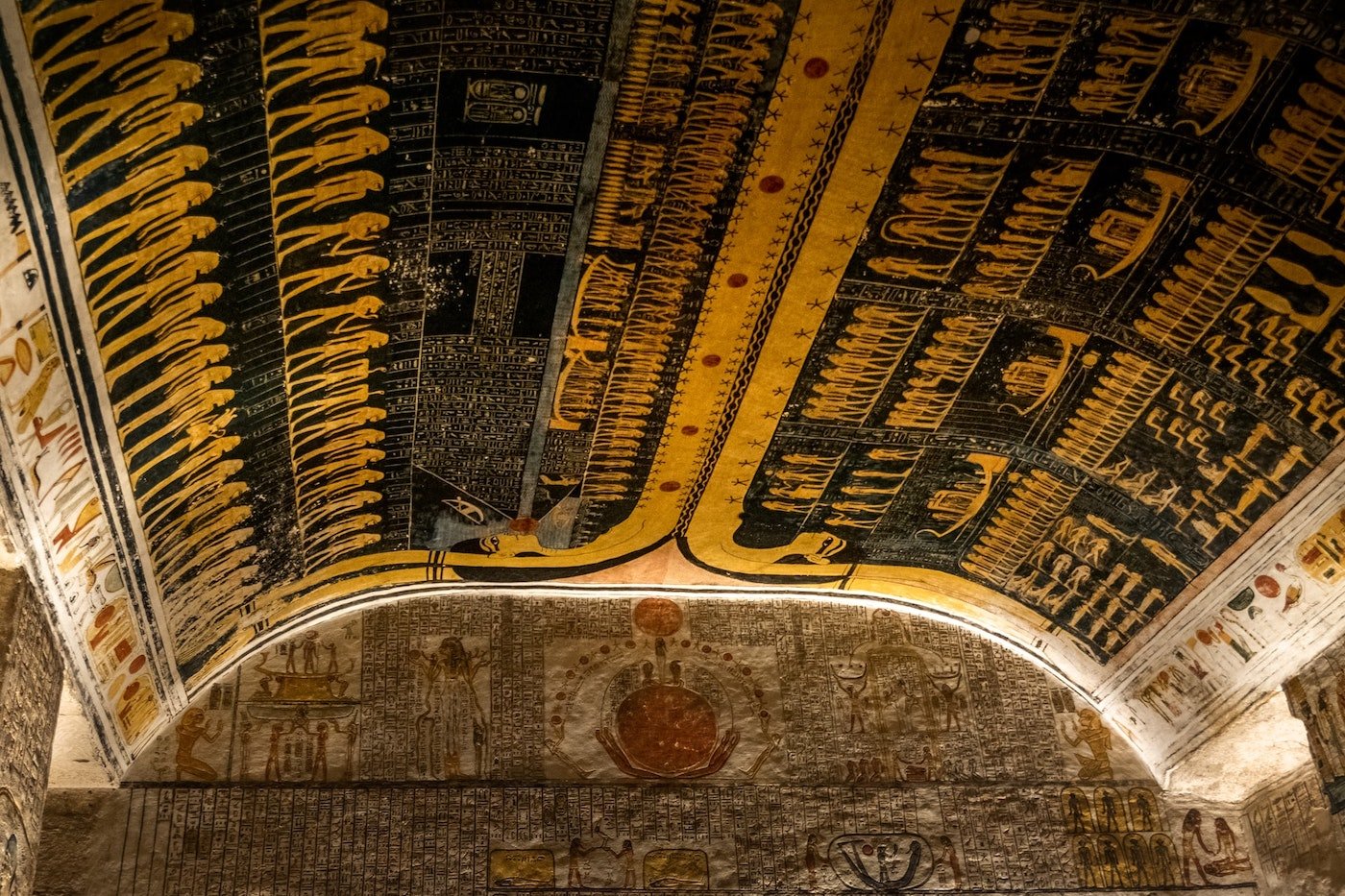
Ramesses IV, KV2. The nearest to the entrance, which makes it crowded, but it has an astronomical ceiling in deep blue with the sky goddess stretched across it and the colour is extraordinary. Short, so it moves quickly even when full.
Merenptah, KV8. Big, steep, and much emptier than the others. The granite sarcophagus lid with the king carved on it is still in the burial chamber. Good if you would rather have space than the very best paint.
A workable alternative is Tausert and Setnakht, KV14, one of the largest in the valley, which almost nobody enters.
Tutankhamun: should you pay the extra?
Probably not, and this is the advice guests argue with most.
KV62 is small, because it was not built for a king and he died young. The famous objects are all in Cairo, in the Grand Egyptian Museum, where you will have already seen them or are about to. What remains in the tomb is the mummy in a climate-controlled case, one gilded coffin, and a single decorated wall.
It is also the most crowded space in the valley by a wide margin. Thirteen dollars for four minutes of shuffling.
Pay it anyway if the story is why you came. Standing in the room Carter opened does mean something, and no amount of sensible advice competes with that. Just do not expect the gold.
Seti I: the one that actually is worth it
Thirty-eight dollars is a lot for one tomb, and it is the best-preserved painted tomb in Egypt. It is the longest in the valley, it goes down a hundred and thirty-seven metres, and the decoration is finished to a standard the others do not reach: raised relief, colour still saturated, an astronomical ceiling in the burial chamber, and unfinished sketches on a lower corridor where the draughtsmen simply stopped.
It reopened after a very long conservation programme and is limited to small numbers, so it is quiet in a way nothing else there is.
If you are going to spend money on one extra ticket in Luxor, spend it here. If the budget only stretches to Tutankhamun or Seti I, take Seti I and read about Carter in the car.
A word on the queens, and on Nefertari
The Valley of the Queens is a separate site a few minutes away, with a separate ticket, and it contains the tomb of Nefertari. That tomb is, by most reckonings, the finest painted interior surviving from the ancient world. It is also the most expensive ticket in Egypt by a distance, sold in limited numbers with a short time limit inside.
Whether it is worth it is a genuine argument even among Egyptologists. The paint is beyond anything in the Valley of the Kings. You get ten minutes. Some guests come out elated and some come out feeling they have been sold a very short film. We will tell you the current price and rules when you book and leave the decision alone.
What most people get wrong about the visit
- Going late. The valley is a stone funnel and it holds heat. At eleven in April it is unpleasant; at eleven in July it is a health risk. The gate opens at six in summer and seven in winter and there is no reason to be anywhere else at that hour.
- Rushing three tombs in forty minutes. You cannot see a painted wall properly until your eyes have adjusted, which takes several minutes in a dim chamber. Two tombs seen slowly beat three seen quickly.
- Believing every tomb is open. They rotate. The three you read about may not be available on the day, which is a good reason to be with someone who can pick again at the gate.
- Forgetting Hatshepsut and the Colossi are right there. A West Bank morning is not only the valley.
Practical
- The little train from the ticket office to the tombs costs a few pounds and saves a hot walk.
- There is no shade at the tomb entrances. Hat, water, and shoes you can walk on gravel in.
- The tombs are dusty and warm inside, and the ramps are steep. Anyone with breathing difficulties should plan for one or two, not three.
- Buy the extra tickets at the main ticket office, not at the tomb.
Our West Bank morning is built around going early and staying longer in fewer places, and your guide will choose the three tombs on the day based on what is open and what is empty.