
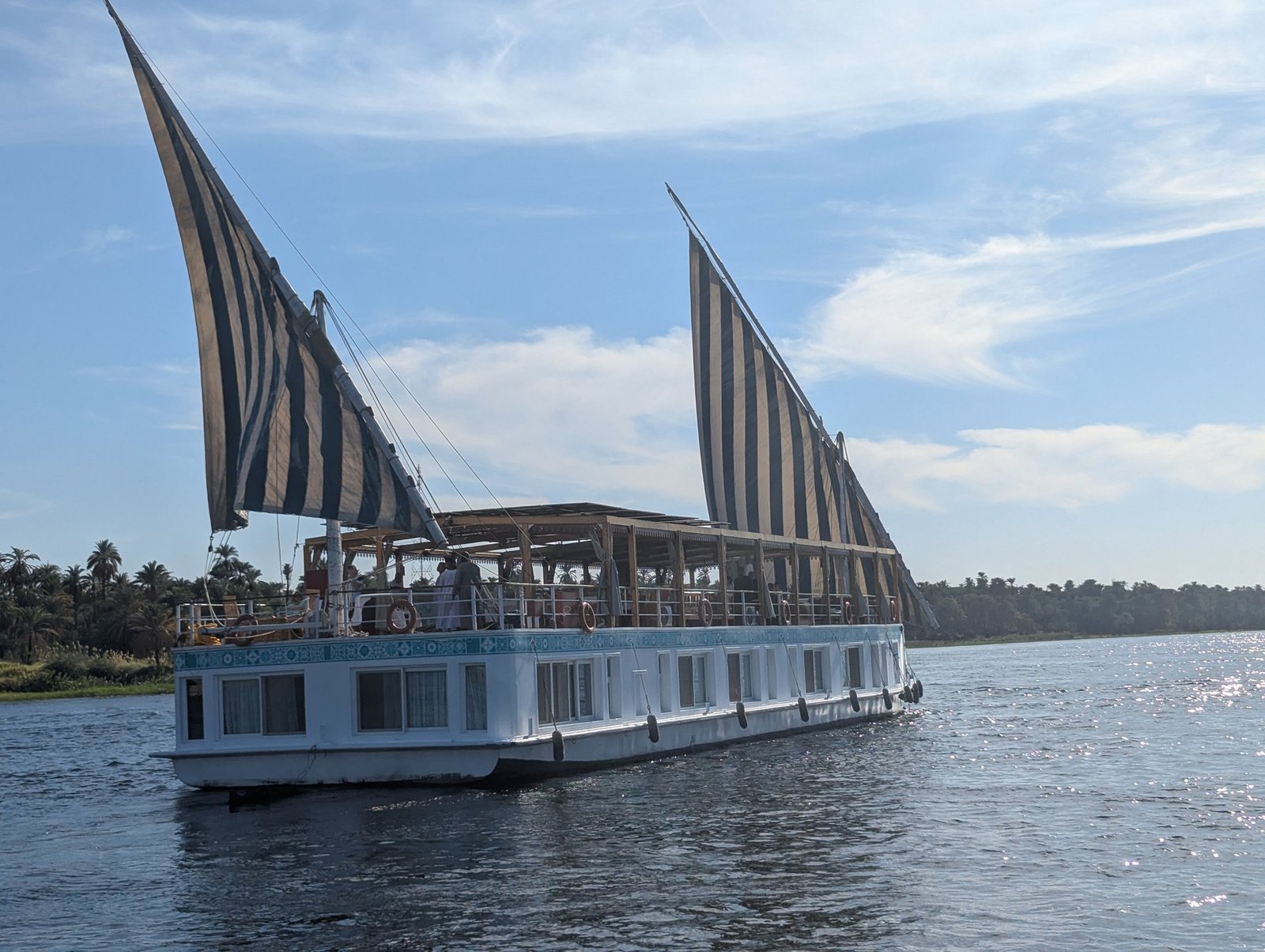
Short answer: if you want quiet, take the dahabeya. If you want comfort and company, take the cruiser. Both sail the same river past the same temples, and the difference between them is not quality. It is what you want a week on the water to feel like.
This is the question we are asked more than any other, usually by people who have already decided they want to do the Nile and cannot work out which boat. So here is the comparison written out properly, including the parts that do not flatter us.
What a dahabeya actually is
A wooden sailing boat with two masts and, typically, six to ten cabins. The design is nineteenth century. Wealthy travellers hired them to go up the Nile before steamers existed, and the boats sailing today are built to the same shape.
They move with the wind and the current. Most carry a small engine or are nudged along by a tug when the wind dies, because otherwise you would occasionally not move at all, but the sails are not decoration. On a good afternoon the engine is off and the loudest thing on board is the water.
Because a dahabeya is small and has a shallow draught, it can moor almost anywhere: a sandbank, an island, the bank below a village. That is the practical difference from which everything else follows.
What a five-star Nile cruiser is
A floating hotel, usually four or five decks, seventy to a hundred and fifty cabins, a sun deck with a pool, a restaurant serving buffets, a bar, and a lift. Cabins are larger than dahabeya cabins and have proper bathrooms and reliable air conditioning.
They run to a fixed schedule and moor at the same handful of quays as every other cruiser. At Edfu and Kom Ombo you will sometimes be rafted three or four boats deep and walk through someone else’s lobby to reach the shore. That is normal and nobody minds much.
The comparison, honestly
| Dahabeya | Five-star cruiser | |
|---|---|---|
| Guests on board | Six to twenty | One hundred and fifty to three hundred |
| Where it moors | Sandbanks, islands, villages | Fixed quays at the main towns |
| Noise at night | Water and wind | Engines and, on some boats, a disco deck |
| Cabin | Small, wooden, characterful | Larger, hotel standard, better bathroom |
| Pool | No | Yes |
| Lift | No | Usually |
| Air conditioning | Variable, often cabin-only | Reliable throughout |
| Food | Cooked for the number on board | Buffet |
| Pace | Weather-dependent, slower | Fixed timetable |
| Price per night | Higher | Lower |
Who should take the cruiser
More people than the romantic write-ups admit. Take the cruiser if you want a reliably cool cabin in April, if stairs are a problem, if you are travelling with teenagers who will be happier with a pool and other people their age, or if the price difference is what decides whether the trip happens at all.
It is also the better choice if fixed times reassure you. A cruiser departs when it says it will. A dahabeya departs when the wind allows, and once or twice a trip that means a changed plan.
Who should take the dahabeya
Take the dahabeya if the thing you are actually buying is quiet. If the memory you want is a sandbank at seven in the morning with nobody else on it, rather than a photograph of Edfu, this is the boat.
It also suits people who dislike being processed. With eight guests, the crew learn your name on the first day and lunch happens when everybody is hungry. Nobody hands you a coloured sticker.
The parts nobody mentions
- Dahabeya cabins are small. Charming, wooden, and smaller than the photographs suggest.
- Air conditioning on a dahabeya is not a hotel system. On many boats it runs on the generator and is switched off overnight. In January this is irrelevant. In May it is not.
- Wind is real. A day can be shortened or a mooring changed. Guests who need certainty find this stressful rather than charming.
- Cruisers are not the horror they are painted. The temples are the same, the guiding can be excellent, and three hundred people spread over five decks is quieter than it sounds.
- Neither boat sails the whole way. Between Esna and Edfu there is a lock and a stretch with little wind. Everyone motors part of it.
A day on each
On the dahabeya. You wake because the light comes through the cabin window, not because of an announcement. Breakfast is on deck. The boat casts off when the wind picks up, usually mid-morning, and you sit and watch the bank go past: buffalo in the shallows, a man on a donkey, children who shout and wave from every village for six days without once getting bored of it. Lunch on board. Early afternoon, the boat noses into a sandbank and you swim, or walk on an island, or do nothing at all. A temple in the late light with almost nobody in it. Dinner cooked for the eight of you, then the deck, and the sky above the Nile with no towns near enough to spoil it.
On the cruiser. Breakfast is a buffet between six and nine. The boat docks and a tender or a short walk takes you to the temple, usually with several other boats arriving at the same time, so the first fifteen minutes are busy and then it thins out. Back on board for a proper lunch. The afternoon sailing is the good part: a lounger on the sun deck, the pool, the bank sliding by exactly as it does from the dahabeya, because it is the same bank. Dinner, then a bar and often some form of entertainment, which you can join or ignore.
Written down, the second day is not worse. It is busier, and it is more like being on holiday than being on the river.
What it costs
At the time of writing, five days between Luxor and Aswan runs around 1,290 dollars per person on our dahabeya and around 890 on the five-star cruiser, both full board with a private Egyptologist and all entrance fees. Roughly a forty per cent premium for the smaller boat.
Whether that is worth it is not something we can answer for you. It buys silence, space and a mooring nobody else can reach. It does not buy a bigger cabin or a better bathroom, and anyone who tells you otherwise has not slept on one.
What we do
We sell both, because the honest answer changes with the guest. Our five-day dahabeya between Luxor and Aswan is the one we run most. The five-star cruiser over the same route costs less per night and works better for guests who want the pool and the lift.
If you describe your trip to us in three sentences, we will tell you which one we think fits, including when that is the cheaper one.