The short answer: a Nile cruise works well from primary-school age, and really well from about eight. With children under five it is hard going and gives little back to anyone involved. The best time of year for families is November to March. And the single most important point: there is no kids’ club. Not anywhere, not on any boat.
We get asked this a lot, and the answers online tend to be either advertising or a forum post from 2011. What follows is what our own guests tell us afterwards – including the things that didn’t go so well.
From what age?
| Age | Honest assessment |
|---|---|
| Under 3 | Doable, but the effort is out of all proportion. No changing table, a cot is not a given, no play area. We advise against it. |
| 3 to 5 | The child gets nothing out of the temples, and you get little out of the trip. At this age, a quiet spot on the Red Sea is the better version of Egypt. |
| 6 to 8 | Works if you adjust your expectations: fewer temples, more boat, more breaks. Mummies and animal-headed gods are hugely popular at this age. |
| 9 to 12 | The ideal age. They understand the stories, cope with the heat, manage the walking – and still remember it twenty years later. |
| Teenagers | Good, as long as they get a say. A tomb they chose themselves is a different tomb. |
What most families underestimate
There is no childcare on a Nile boat. No club, no entertainment team, no programme. That isn’t a shortcoming of one particular operator; it applies to the entire Nile fleet. Most passengers are over fifty, and the boats are set up for them.
Which means: on board, the entertainment is down to you. That sounds like work, and is actually the nicer part. Between two temples you sit on the sun deck while the riverbank drifts past – water buffalo, palm trees, children on the bank waving. A pair of binoculars is the best toy you can bring.
Cruise ship or dahabeya – with children?
This is the question that makes the difference, and the answer is different for families than for couples.
| Large cruise ship | Dahabeya (sailing boat) | |
|---|---|---|
| Guests on board | 120 to 300 | 8 to 12 |
| Pool | almost always | usually not |
| Other children on board | occasionally | practically never |
| Temple visits | at group pace, fixed times | scheduled as you like |
| Calling it a day when the child has had enough | difficult | any time |
| Room to move | lots of deck, lots of stairs | compact, everything in view |
| Noise level | engine, music, evening entertainment | wind and water |
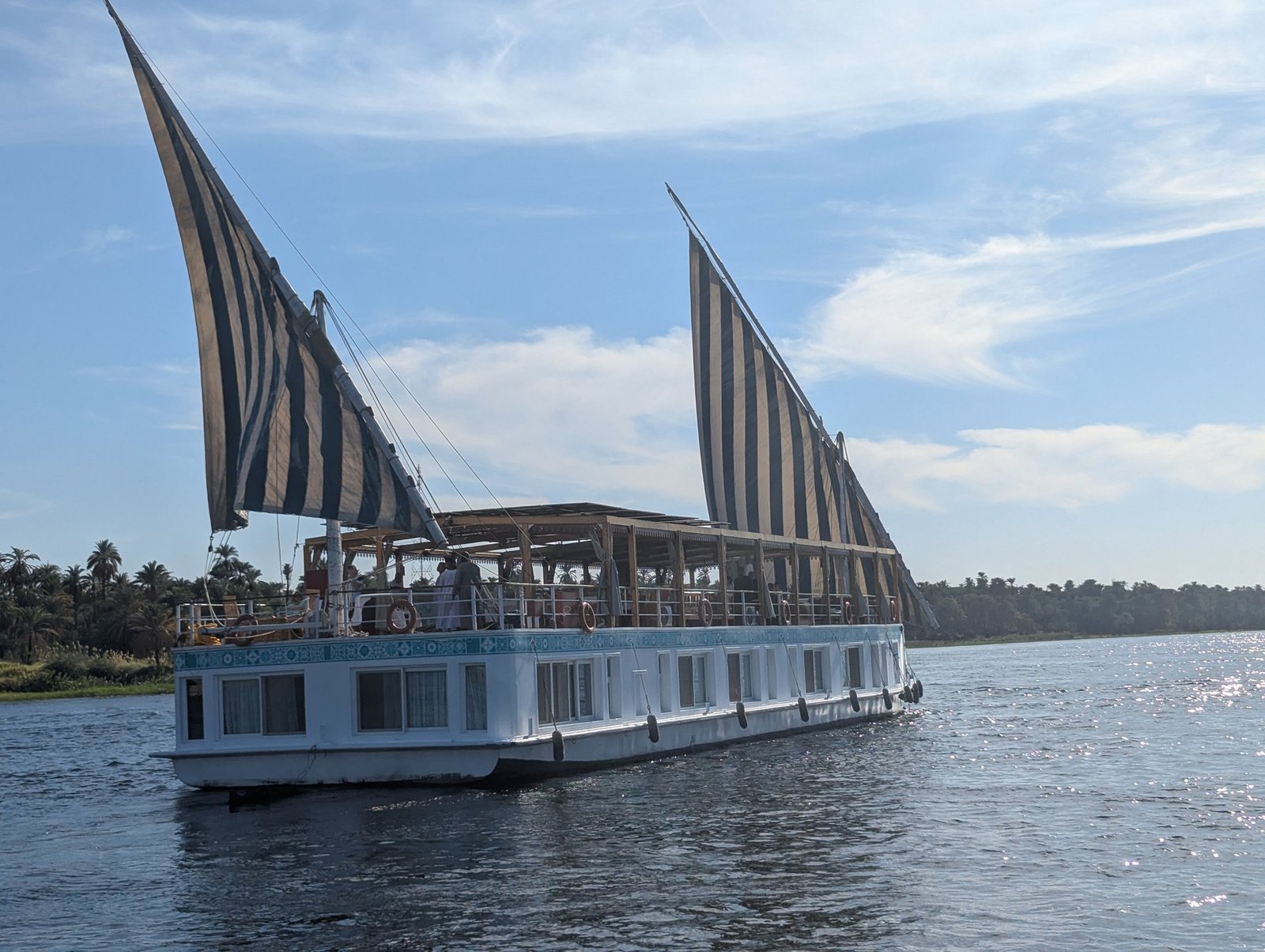
For children under eight, a large ship is usually the better choice: a pool, space, perhaps other children. From eight, that flips. Then the dahabeya is the better place, because you aren’t herded through Karnak at the pace of a sixty-person group, and because after two days the crew know your child’s name and what they eat. We’ve set out the basic difference in detail here: Dahabeya or cruise ship.
One caveat we won’t hide: a dahabeya usually has no pool and no second child to play with. If your child needs company, take that seriously.
Safety on board
Nile boats are not ferries with a safety notice on the wall. What you can do:
- Ask before booking how high the railing on the sun deck is and whether there are children’s life jackets on board. An operator who can’t answer that straight away has given you your answer.
- On the first day, walk the whole boat once with your child. Where the stairs are, where the way out to the deck is, where your cabin is.
- Swimming in the Nile is not a good idea. Currents, boat traffic, bilharzia. In a hotel pool, yes; in the river, no.
- Bring your own first-aid kit. Electrolyte sachets, children’s fever medicine in the dose you’re used to, children’s diarrhoea remedies. There are pharmacies locally, but not with what you know.
Heat, and why timing decides everything
In Luxor and Aswan, 42 degrees is normal in July and August. Adults manage with shade and water; children wilt quickly in that heat, and an overheated child won’t do any more temples.
| Months | For families |
|---|---|
| November to February | Ideal. 22 to 27 degrees during the day, cool in the evening. Pack a warm jacket. |
| March, April, October | Good. 28 to 34 degrees. Out in the morning, rest at midday. |
| May, September | Borderline. Over 35 degrees; the programme has to adapt. |
| June to August | We advise against it with children. It isn’t the 42 degrees, it’s the third hour of it. |
What children actually find interesting in Egypt
In our experience, three things, pretty reliably: mummies, hieroglyphs and cats. Everything else is up for negotiation.
- Tombs beat temples. A royal tomb is a cave with colourful pictures and a dead person at the end – every child gets that immediately. A hall of columns is architecture, and architecture is hard to tell as a story. Which tombs are open changes: Valley of the Kings: which tombs are worth it.
- Writing their own name in hieroglyphs. Works every time. Print out the list of signs beforehand and they’ll have something to do on the journey.
- Animals. Donkeys, water buffalo, goats on the roof, herons on the bank, cats everywhere. An afternoon with a farming family on the West Bank does more for most children than a third temple.
- Getting around under their own steam. A horse-drawn carriage, a felucca, a bicycle. The bike tour across the West Bank works from about age ten and is regularly the highlight of the trip for children.
- Their own camera or notebook. Children who document things themselves look more closely.
The daily rhythm that works
Out early, done early. Temple visits happen between six and ten in the morning; after that it gets hot and loses its appeal. The afternoon belongs to the boat: deck, shade, card games, watching the riverbank. If you try to keep to a European daily routine, you’re fighting the sun, and you’ll lose.
And don’t be afraid to skip things. If your child has had enough after the fourth temple, the fifth is no gain. The guide can wait with them in the shade at the entrance, or you head back to the boat. That isn’t a lost item on the itinerary; it’s the reason the rest of the trip still goes well.
Practical things people forget
- A passport for every child, valid for at least six months. A child’s passport is fine; being listed in a parent’s passport has not been accepted for years.
- A visa is needed even for a baby.
- Be consistent with sun protection. A long-sleeved UV shirt beats any sun cream, because you don’t have to reapply it.
- No tap water, not even for brushing teeth. Ice only where you’d also trust the food.
- Adapter and power bank. Egypt uses Type C, i.e. European two-pin plugs – but there are fewer sockets on the boat than a family needs.
- Small notes for tips. A family trip brings more occasions for tipping than any other kind.
And if a whole boat is too much?
Not every family has to do a Nile cruise. Sometimes the better version is a week in Luxor with one base, day trips from there at your own pace, and the pool in between. No suitcases, no schedule, and if a day falls through, so be it.
We plan both. Write to the Orientoura team with your children’s ages and how much time you have, and we’ll tell you honestly which option suits you – including if we think you should wait another two years. For families, a classic Nile cruise and a dahabeya trip really are two different holidays.
Before booking, sort out two things that go wrong faster with children than without: the right month – in high summer, Upper Egypt is tough on children – and the entry requirements, because children need their own passport and their own visa too.
If you’d like to turn this into a whole trip: our seven-day private family Nile journey is built on exactly these rules – one sight in the morning, afternoons free, a boat with a pool.
Auf Deutsch lesen: Nilkreuzfahrt mit Kindern: Ab welchem Alter funktioniert das?